Address
304 North Cardinal
St. Dorchester Center, MA 02124
Work Hours
Monday to Friday: 7AM - 7PM
Weekend: 10AM - 5PM
Address
304 North Cardinal
St. Dorchester Center, MA 02124
Work Hours
Monday to Friday: 7AM - 7PM
Weekend: 10AM - 5PM
A matching number on the pump and pipe does not guarantee a drop-in replacement. Learn how to check nominal pipe size, slip sockets, threads, unions, alignment, and hydraulic capacity before ordering a pool pump.
A 1.5-inch or 2-inch label does not by itself tell you whether a pool pump will fit your plumbing. A compatible replacement must match the connection style, the correct union or adapter, the pipe’s nominal size and actual outside diameter, the pump’s port locations, and the hydraulic needs of the complete system.
A reducer can sometimes make a 2-inch pump connection attach to 1.5-inch plumbing, but it does not turn the existing system into a 2-inch system. The longer 1.5-inch pipe runs, valves, filter, heater, sanitizer, and pool outlets still determine how much resistance and safe flow capacity the system has.
Quick answer: Identify the existing pipe or hose, then check whether the new pump uses a slip/socket connection, NPT threads, a model-specific union, or a hose adapter. Confirm the exact union kit, suction and discharge sizes, port height and spacing, required flow at total dynamic head (TDH), and every connected equipment limit. Never assume that two unions are interchangeable because both are called 1.5 inch or 2 inch.
The PUREBY rule: An approved adapter may solve a physical connection mismatch. It cannot solve a hydraulic mismatch.
This guide explains replacement compatibility, not how to redesign suction outlets or pressure-test pool plumbing. Turn off electrical power, prevent automatic restart, close or isolate water paths as the equipment manuals require, and fully relieve filter pressure before loosening a union or opening the system. Have a qualified pool professional evaluate buried plumbing, suction-outlet safety, major replumbing, or an uncertain installation.
A connection is compatible only when the physical fitting, installed geometry, and hydraulic system all work together.
| Existing plumbing and new pump | Can they connect? | What still needs verification |
|---|---|---|
| 1.5-inch rigid PVC to a 1.5-inch slip/socket union | Often, with the union supplied or approved for the pump | Actual pipe OD, socket type, union kit, specified seal, alignment, and hydraulic limits |
| 2-inch rigid PVC to a 2-inch slip/socket union | Often, with the correct union assembly | Union compatibility, centerline dimensions, straight-run space, flow, and equipment limits |
| 1.5-inch pipe to a dual-size fitting described as “1.5-inch internal slip / 2-inch external slip” | Often—the pipe uses the matching part of that fitting | The exact manual and supplied union still control |
| 1.5-inch pipe to a 2-inch-only pump connection | Sometimes, with an approved reducer or transition | Whether reduction is permitted, suction velocity, TDH, pump curve, and connected equipment |
| 2-inch pipe to a 1.5-inch-only pump connection | Sometimes, with an approved transition | Local restriction, pump curve, serviceability, and whether the pump is suitable for the system |
| Corrugated above-ground hose to a rigid-PVC pump port | Only with the correct hose adapter or union kit | Nominal hose size, actual cuff/barb mating dimensions, clamp method, pressure/vacuum rating, and pump manual |
| Old union nut attached to a different pump brand or model | Do not assume it fits | Nut thread, tailpiece face, seal type and size, sealing geometry, and approved part number |
“Often” does not mean “drop-in.” Even when the pipe size is correct, a replacement pump may have a different suction-port height, discharge orientation, base length, or distance between the union faces.
Pool-plumbing sizes are usually nominal sizes, so a 1.5-inch PVC pipe does not measure 1.5 inches across its outside surface.
For common Schedule 40 pressure pipe, Charlotte Pipe’s published dimensions show:
| Nominal pipe size | Actual outside diameter | Approx. inside diameter (Schedule 40) | What to measure in the field |
|---|---|---|---|
| 1.5 inches | 1.900 inches (48.26 mm) | 1.610 inches | Measure the straight pipe OD, not the union nut |
| 2 inches | 2.375 inches (60.33 mm) | 2.067 inches | Measure the straight pipe OD, not the fitting body |
Inside diameter varies with pipe schedule, wall thickness, product type, and manufacturing tolerances. Flexible hose and corrugated above-ground-pool hose may use a different sizing system altogether. That is why a tape measurement of a hose cuff or union nut cannot reliably identify the plumbing size.
The safest identification sequence is:
“Port size” is incomplete information because the same nominal size can use a socket, tapered thread, removable union, or hose connection.
| Connection type | How it works | Compatibility rule |
|---|---|---|
| Slip or socket | Rigid PVC pipe is solvent-welded into a correctly sized socket | Pipe OD, socket size, material, and joining procedure must match |
| NPT threaded port | Matching male and female NPT components form the tapered threaded connection | Confirm size, thread standard, approved adapter, and sealant procedure in the manual |
| Union | A nut pulls a model-specific tailpiece and specified seal—an O-ring or gasket—against the pump’s mating face | Treat the nut, tailpiece, and seal as one matched assembly |
| Hose barb, cuff, or proprietary hose adapter | Flexible hose seals over or into a shaped adapter | Use the hose and adapter specified for that equipment; nominal PVC size is not enough |
Some fittings accept two pipe sizes in different ways. For example, Pentair describes the SuperFlo connection as 1.5-inch internal slip and 2-inch external slip. This specific Pentair connection is designed to accept the stated 1.5-inch internal-slip or 2-inch external-slip plumbing arrangement. It does not make unrelated 1.5-inch or 2-inch union parts interchangeable.
Thread standards matter as well. Spears’ technical guide distinguishes U.S. NPT threads from BSP threads and states that they are not compatible. Threads that begin to engage are not necessarily a correct or pressure-tight match.
No. Pool-pump unions with the same stated pipe size are not automatically interchangeable.
A pump union normally includes:
Two union nuts may look similar but use different thread pitch, diameter, depth, seal dimensions, or mating-face geometry. Reusing the old nut while discarding the old tailpiece—or combining parts from two kits—can create a joint that tightens without sealing correctly.
Use the union assembly included with the new pump or a replacement kit that the pump manufacturer lists for that exact model. If the installed tailpiece must be retained, confirm compatibility by approved part number rather than appearance alone.
This is also why the cleanest replacement is not always the pump with the same advertised port size. A different model may require the pipe to be cut back far enough to install its complete union kit without putting sideways or vertical stress on the pump housing.
PUREBY can provide purpose-selected fittings and adapters that connect its 1.5-inch- or 2-inch-connection pool pumps to either 1.5-inch or 2-inch rigid plumbing.
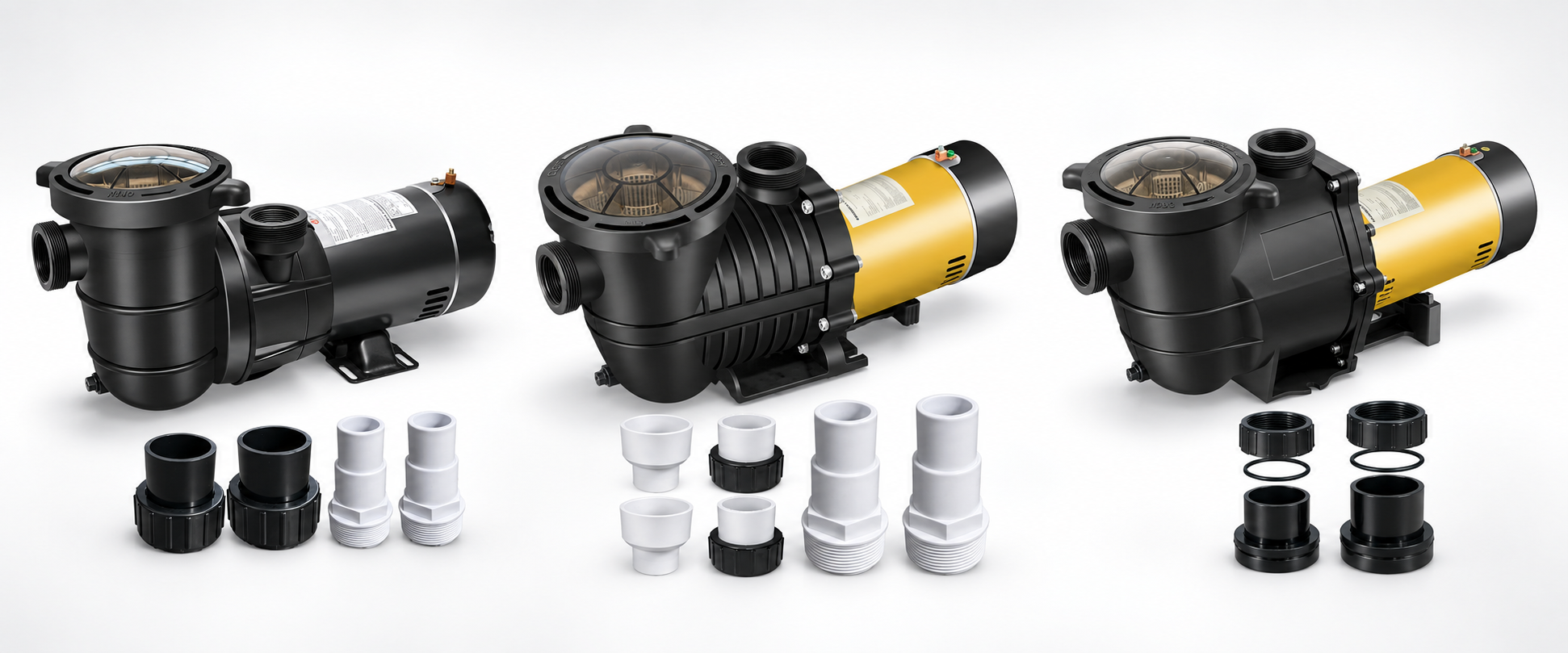
Illustrative comparison assembled from actual PUREBY product references. From left: an above-ground pump with rigid-pipe fittings and 32 mm / 38 mm nominal hose adapters; a 1.5-inch-connection pump with rigid-pipe and hose-adapter options; and a 2-inch-connection pump with alternative 1.5-inch and 2-inch sockets that use the same pump-side threaded ring, with a sealing gasket between the ring and socket. This is not a dimensional drawing; confirm the exact parts and package contents before ordering.
For customers matching a PUREBY pump to existing plumbing, the available connection paths include:
| PUREBY pump connection | Existing plumbing | Available PUREBY connection option |
|---|---|---|
| 1.5-inch | 1.5-inch U.S. IPS / Schedule 40 pipe: 1.900-inch OD (48.26 mm) | Matching 1.5-inch pipe fitting or adapter |
| 1.5-inch | 2-inch U.S. IPS / Schedule 40 pipe: 2.375-inch OD (60.33 mm) | Matching transition fitting or adapter |
| 2-inch | 1.5-inch U.S. IPS / Schedule 40 pipe: 1.900-inch OD (48.26 mm) | Matching transition fitting or adapter |
| 2-inch | 2-inch U.S. IPS / Schedule 40 pipe: 2.375-inch OD (60.33 mm) | Matching 2-inch pipe fitting or adapter |
| 1.5-inch | 32 mm or 38 mm nominal flexible pool hose | PUREBY 1.5-inch-to-32 mm or 1.5-inch-to-38 mm hose adapter |
PUREBY Engineering confirms that these rigid-pipe fittings are designed for the U.S. IPS / Schedule 40 outside diameters—not separate 48.0 mm or 60.0 mm metric pipe standards. The 32 mm and 38 mm descriptions refer to nominal pool-hose sizes, so a measurement taken across a hose cuff may not equal the stated nominal size. Confirm the exact PUREBY pump model, pipe or hose type, and required adapter before ordering. Adapter availability does not mean every adapter is included with every pump, and it does not make unrelated union nuts, tailpieces, or seals interchangeable.
These options solve the physical transition at the pump. The pipe length, hose construction, filter, equipment, suction outlets, target GPM, and TDH must still pass the hydraulic compatibility checks in this guide.
At the same GPM, 2-inch Schedule 40 pipe carries water at a lower velocity than 1.5-inch Schedule 40 pipe because its internal flow area is larger.
Using the Charlotte Pipe nominal inside diameters above, 2-inch Schedule 40 pipe has about 65% more internal cross-sectional area than 1.5-inch Schedule 40 pipe. The following calculations show the resulting water velocity at the same flow:
| Example flow | 1.5-inch Schedule 40 PVC | 2-inch Schedule 40 PVC |
|---|---|---|
| 30 GPM | approximately 4.7 ft/s | approximately 2.9 ft/s |
| 40 GPM | approximately 6.3 ft/s | approximately 3.8 ft/s |
| 50 GPM | approximately 7.9 ft/s | approximately 4.8 ft/s |
These are geometry-based examples, not universal design limits or recommendations. They assume the published nominal inside diameters and do not include valves, elbows, fittings, hose deformation, equipment losses, or parallel lines.
The U.S. Department of Energy’s pumping-system guidance explains that pipe friction rises strongly with velocity; in the Darcy-Weisbach relationship, head loss includes a velocity-squared term. In a real pool system, smaller pipe, longer runs, more fittings, and higher flow can all increase TDH and move the pump to a different operating point.
For a variable-speed pump operated to a target flow, lower system resistance can allow the required GPM to be delivered at a lower speed and potentially lower input power. A fixed-speed pump cannot reduce RPM; lower resistance usually shifts its operating point toward higher flow, so do not assume its input power or running cost will fall. The complete pump curve, operating speed, target GPM, TDH, run time, and equipment limits still matter.
Pipe-size charts disagree because they may use different velocity criteria, pipe schedules, safety assumptions, and model-specific instructions.
For example, the cited Jandy FHP pump manual gives this Schedule 40 PVC reference table for that product family:
| Nominal pipe size | Flow at 6 ft/s on suction side | Flow at 8 ft/s on discharge side |
|---|---|---|
| 1.5 inches | 37 GPM | 50 GPM |
| 2 inches | 62 GPM | 85 GPM |
Those figures are useful for understanding the difference in pipe area, but they are not permission to operate every residential pool system at those flows. The filter, heater, sanitizer, valves, suction outlets, fittings, and local rules may impose lower limits.
In that manual, the table is used for equipment installations up to 100 feet from the water; Jandy instructs installers to increase the pipe size by another 1/2 inch for each additional 50 feet. This is a model-specific installation condition, not a universal rule for every pump.
The PHTA-hosted GENESIS Hydraulic Safety Position Statement recommends using the pump’s maximum flow at maximum RPM as the reference flow for new-system line sizing and suction-outlet evaluation, even when a speed-lock feature is available. For retrofits only, it allows a variable-speed pump to be locked at a lower maximum speed so the flow cannot exceed the existing plumbing or suction-outlet configuration. The statement also recommends limiting design velocity on the pump suction side to 5 ft/s and identifies itself as a voluntary position statement rather than a consensus standard or building code.
The practical rule is simple: use the criteria required by the exact equipment manuals, the suction-outlet ratings, the locally adopted code, and the authority having jurisdiction. Do not size a system from a generic internet chart alone.
A 2-inch pump connection can sometimes be adapted to 1.5-inch plumbing, but physical connection does not prove hydraulic compatibility.
Before using a reducer, confirm all of the following:
A short, approved reducer at the equipment pad is not hydraulically equivalent to an entire run of smaller pipe. However, it still creates a local restriction, and it cannot erase the effect of the existing 1.5-inch system.
A pump with 1.5-inch connections may sometimes attach to 2-inch plumbing through an approved transition, but the pump still must be selected from its performance curve and installation manual.
Keeping most of the system in 2-inch pipe can preserve much of the lower resistance of the larger line. The short transition and pump port still add local loss, but they do not automatically make the entire run behave like 1.5-inch pipe.
This arrangement is acceptable only when:
Do not choose the smaller-port pump simply because an adapter exists. Port size, horsepower, and pipe size are each only one part of pump selection. Use the complete process in How to Choose the Right Pool Pump: Size, GPM, TDH, HP & Voltage.
Before calling a replacement pump “compatible,” verify that it can connect, carry the required water, and remain serviceable.
If any one of these three checks fails, the pump is not a true drop-in replacement even if an adapter can make the parts touch.
Measure the installed system, not only the old pump’s advertised connection size.
With power off and the system left closed unless a qualified person is servicing it, collect:
Do not loosen a union just to measure it unless power is isolated, automatic controls cannot restart the pump, flooded lines are isolated as required, and the filter is fully depressurized.
The most common replacement failures occur when the nominal size matches but the union, hose type, or port geometry does not.
| Scenario | Best preliminary interpretation | Main risk to avoid |
|---|---|---|
| Old pump and new pump both say 1.5-inch union | May still require the new pump’s complete union kit | Assuming the old union nut and seal are universal |
| New pump includes 1.5-inch internal / 2-inch external slip unions | Use the intended socket for the existing rigid PVC size | Gluing into the wrong surface or discarding required union parts |
| Existing pool uses 1.5-inch corrugated hose | Treat it as a hose system, not automatically as 1.5-inch rigid PVC | Buying a slip or NPT fitting that does not match the cuff or barb |
| Existing underground lines are 1.5-inch; new pump has 2-inch ports | A reducer may solve the physical transition if the manual allows it | Assuming the larger port upgrades the underground hydraulics |
| Existing lines are 2-inch; new pump has 1.5-inch ports | An approved local transition may be possible | Ignoring pump-curve performance or creating a service-unfriendly bottleneck |
| New pump inlet is higher or farther forward | Replumbing may be required even when size matches | Pulling rigid pipe into alignment and stressing the pump housing |
| Prime problems started after replacement | Inspect the new union, specified seal, adapters, plugs, and alignment | Treating an air leak as a pump-performance defect |
If a pump began losing prime after connection work, use the suction-side checks in Pool Pump Losing Prime? 9 Problems to Check. A misaligned suction-side union or incorrect suction-side seal can admit air even when the nominal pipe size is correct.
Most connection problems come from treating one visible dimension as proof that the entire assembly matches.
Avoid these common mistakes:
Every extra fitting adds resistance. More importantly, every unnecessary joint becomes another possible leak or service point.
An upgrade is most valuable when the larger pipe is carried through the meaningful length of the hydraulic path, not only for the final few inches beside the pump.
Two-inch plumbing may be worth evaluating when:
One-and-a-half-inch plumbing may remain appropriate for a smaller or lower-flow system when the pump, pipe length, filter, hoses, fittings, and outlets are all within their approved operating conditions.
Do not replace sound underground pipe solely because a new pump offers a 2-inch connection. First compare the expected operating point and energy use with the cost and disruption of replumbing. Conversely, do not force a high-flow pump onto an existing 1.5-inch system simply because a reducer is inexpensive.
Do not order the replacement until connection type, installed geometry, hydraulics, equipment limits, and electrical compatibility have all been checked.
Sometimes. An approved reducer or dual-size union may make the physical connection, but the pump manual must permit the arrangement and the existing 1.5-inch system must be evaluated for flow, velocity, TDH, equipment limits, and suction-outlet safety. The reducer does not make the rest of the system 2 inch.
Sometimes. A manufacturer-approved union or transition can connect the sizes, and keeping most of the run at 2 inches can still reduce friction. Final selection depends on the pump curve, target GPM, TDH, port geometry, and connected equipment—not the adapter alone.
Not across the outside. Common 1.5-inch Schedule 40 PVC has an outside diameter of about 1.900 inches, while common 2-inch Schedule 40 PVC has an outside diameter of about 2.375 inches. Measure straight pipe and verify its markings; do not measure the union nut.
No. The advertised size usually describes the pipe the tailpiece accepts, not a universal pump-side nut or mating face. Nut threads, tailpiece geometry, and seals can differ by brand and model. Use the union kit approved for the exact pump.
No. Port size alone does not determine flow. Actual flow is established by the interaction between the pump curve and system resistance, then limited by the filter, plumbing, heater, sanitizer, valves, and pool outlets.
It can reduce hydraulic resistance at a given flow, which may let a compatible variable-speed pump meet the same need at a lower speed. Savings are not automatic and depend on the complete plumbing path, pump efficiency, speed, run time, target GPM, and TDH.
Only when the manufacturer or approved parts documentation confirms that the old union assembly is compatible with the exact new pump. A nut that starts threading onto the new pump is not proof that the mating face and specified seal match.
Not necessarily. Flexible and corrugated hoses may be identified by a nominal inside diameter, cuff, or proprietary adapter system. Confirm the exact hose dimensions, connection method, and manufacturer-approved adapter instead of buying a rigid-PVC fitting by label alone.
PUREBY can provide fittings or adapters that connect its 1.5-inch- and 2-inch-connection pool pumps to either 1.5-inch U.S. IPS / Schedule 40 pipe with a 1.900-inch OD (48.26 mm) or 2-inch pipe with a 2.375-inch OD (60.33 mm). For flexible above-ground-pool plumbing, PUREBY can also provide adapters for 32 mm and 38 mm nominal pool hose. Confirm the exact pump model and whether the required adapter is included or optional before ordering.
Follow the exact pump and equipment manuals. The transition must be located and oriented so it does not create an air trap, force the piping out of alignment, violate a required straight run, or reduce the suction line below the permitted size. If the manual is unclear, have a pool professional design the connection.
The right pool-pump connection is not simply “1.5 inch” or “2 inch.” It is a matched combination of pipe or hose size, connection style, union components, installed geometry, and hydraulic capacity.
Use three questions before ordering:
A reducer may solve a physical-size difference when the pump manual permits it. It cannot correct an undersized hydraulic system, an incompatible union, a misaligned equipment pad, or a pump selected for the wrong operating point.
Written by: Catherine Z.
Technical review: David Z.
Last reviewed: September 25, 2026