Address
304 North Cardinal
St. Dorchester Center, MA 02124
Work Hours
Monday to Friday: 7AM - 7PM
Weekend: 10AM - 5PM
Address
304 North Cardinal
St. Dorchester Center, MA 02124
Work Hours
Monday to Friday: 7AM - 7PM
Weekend: 10AM - 5PM
A pool pump usually loses prime because it is short of water, drawing air through the suction side, or unable to move water through a restriction. Use the symptoms in the pump basket, return jets, and filter pressure gauge to narrow the cause before replacing the pump.
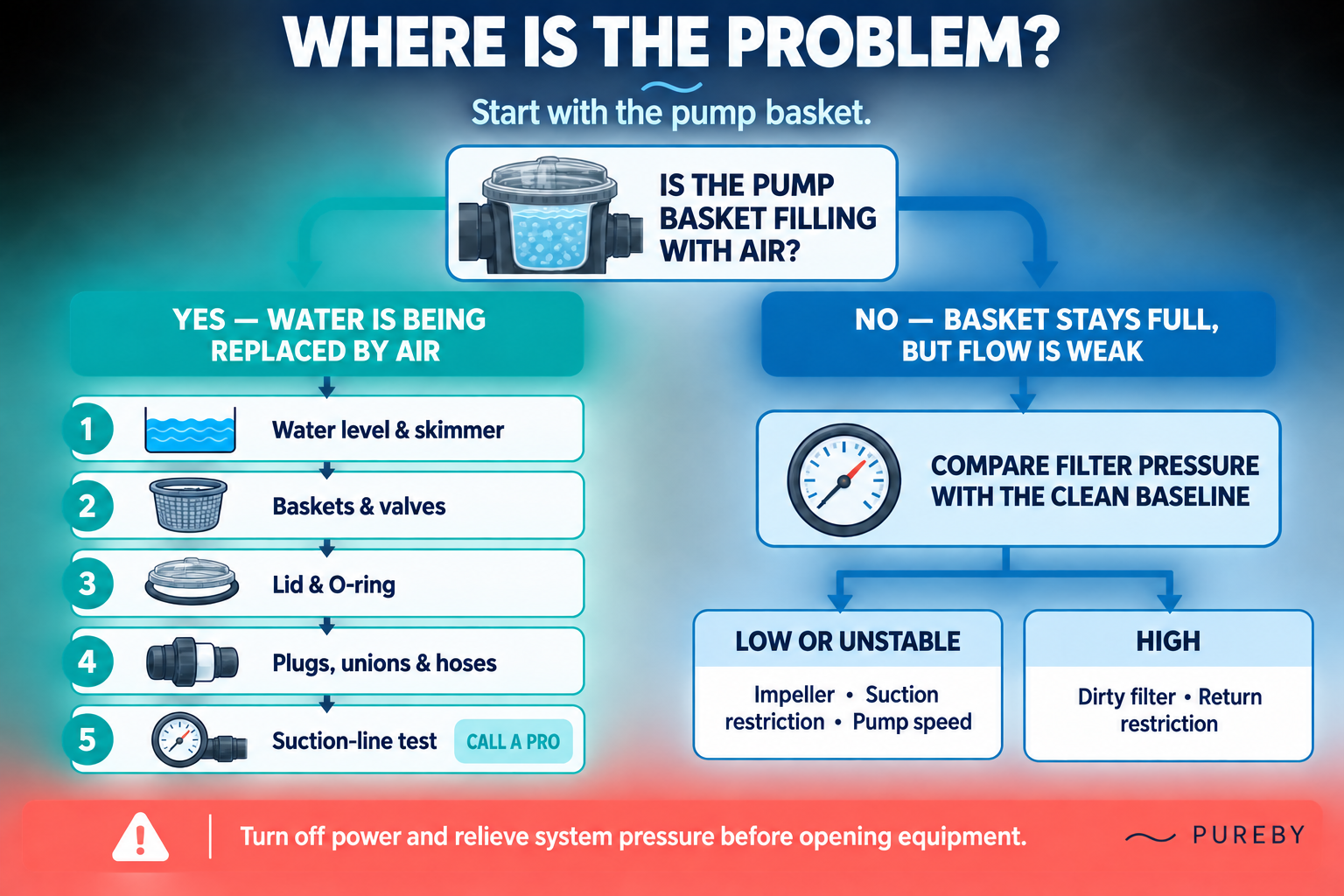
A pool pump loses prime when it can no longer maintain a continuous, water-filled suction path and pump housing. This usually happens because air enters the suction system or because the pump’s water supply is interrupted. The most common causes are a low pool-water level, a starved skimmer, a clogged basket or suction line, or an air leak at the pump lid, O-ring, drain plug, union, valve, hose, or underground pipe.
If the motor is running but the pump basket is emptying, surging, or filling with large pockets of air, shut the pump off rather than letting it run dry. A dry-running pump can damage its mechanical seal and other components. Pentair’s SuperFlo VS/VST manual, for example, specifically warns that low water at the skimmer can make the pump draw air, lose prime, and run dry.
Quick answer: Start with the pool water level and skimmer, then verify the pump was filled and the suction valves are open. Clean the skimmer and pump baskets. If air remains under the clear pump lid, or unexplained bubbles come from the return jets after startup, inspect the pump-lid O-ring and every suction-side plug, union, valve, hose, and fitting. First rule out normal gas from any salt-chlorine, ozone, spa-air, or other gas-producing equipment. If the pump basket stays full of water but flow is still weak, the problem may not be prime at all—it may be an impeller, filter, return-side, speed, or motor issue.
This article is a diagnostic guide, not a substitute for the exact pump and filter manuals. Turn off power and relieve system pressure before opening or servicing any component. Electrical work, underground leak testing, pump disassembly, and repairs to pressurized filter equipment belong with qualified professionals.
The fastest diagnosis begins by matching what you see to the side of the system most likely to contain the fault.
| What you observe | Most likely fault zone | What it usually means |
|---|---|---|
| Pump basket will not fill at initial startup | Water supply, startup procedure, or suction side | Pool water is unavailable, a valve is closed, the pot was not filled, or air is entering the suction path |
| Pump fills, then the water level drops or surges while running | Skimmer or suction side | The pump is being starved for water or is pulling in air |
| Large bubbles remain under the clear lid, or unexplained bubbles appear at return jets | Usually the suction side; first rule out gas-producing equipment | Air may be entering before the pump or at the strainer housing; downstream equipment can also create return bubbles |
| Pump stays primed while running but drains back after shutdown | Suction-side seal, plumbing, or a model-approved check-valve location | Air is entering the closed system and allowing water to drain backward |
| Pump basket stays mostly full, flow is weak, and filter pressure is lower than the clean baseline | Suction restriction, clogged impeller, low speed, or internal pump problem | The pump has water but cannot receive or move enough of it |
| Pump basket stays full, flow is weak, and filter pressure is higher than the clean baseline | Dirty filter or return-side restriction | This is usually a pressure-side flow problem, not loss of prime |
| Motor is silent, hums, overheats, or trips a breaker | Electrical or mechanical fault | Diagnose the motor/circuit safely; adding water will not solve it |
Return-jet bubbles are not always proof of a suction leak. Salt chlorine generators, ozone systems, spa-air systems, and other equipment may generate or intentionally introduce gas. Compare the symptom with the normal operation of those devices before diagnosing a suction-side leak. For example, Pentair’s iChlor salt chlorine generator manual addresses plumbing placement intended to prevent generated gas from becoming trapped in the pool plumbing.
Filter-gauge readings must be compared with that system’s normal clean-filter baseline. One pressure number cannot diagnose every pool.
Start with the pump basket, then use filter pressure relative to the clean-system baseline to determine whether the next check belongs upstream or downstream.
A pump that contains air or cannot establish a continuous water column has a prime problem; a water-filled pump with weak circulation may have a different flow problem.
“Priming” means filling the pump housing and suction path with enough water to remove air and establish circulation. A pump that never fills after service will not prime. A pump that starts with water but later fills with air loses prime. A pump whose basket stays full while the returns become weak may still be primed.
That distinction matters because a dirty filter, a return valve in the wrong position, a low variable-speed setting, or a clogged impeller can reduce flow without causing the pump housing to drain.
The most useful PUREBY diagnostic rule is:
Air replacing water in the pump basket points upstream toward the pool, skimmer, suction plumbing, or strainer seals. A water-filled basket with weak flow points toward a restriction, pump-performance issue, filter, or return side.
If the pump is not running dry and the equipment can be observed safely, note:
Pentair’s Posi-Clear RP filter manual identifies low pool water, a clogged skimmer basket, a split suction-cleaner hose, a pump-lid leak, and a suction-line leak as common sources of air visible in the pump pot or at the returns.
Turn off the pump at its electrical source, prevent automatic restart, and release filter pressure according to the equipment manuals before opening the pump, filter, unions, drain plugs, or valves.
The U.S. Consumer Product Safety Commission advises pool owners to know how to turn off power to pool equipment and to use a qualified electrician for pool electrical work.
Low water or an interrupted supply at the skimmer can make the pump alternate between water and air, causing it to surge and eventually lose prime.
Restore the water to the range specified by the pool and skimmer manufacturer, free the weir door, remove debris, and correct the approved valve setting. As one model-specific example, Pentair’s SuperFlo VS/VST manual calls for maintaining the water approximately halfway up the skimmer opening. The instructions for the actual pool and skimmer still control.
If the water level keeps falling, find the reason for the water loss rather than repeatedly topping up the pool.
After cleaning, winterizing, plumbing service, or a power outage, a dry pump pot, closed suction valve, closed return path, or trapped air can prevent initial prime.
Follow the pump manufacturer’s complete priming procedure. A typical self-priming-pump procedure includes filling the strainer pot to the specified level, correctly installing the lid and O-ring, opening the required suction and return paths, opening the filter air relief, and starting the pump while standing clear of the filter. Close the relief valve only when the equipment manual says to do so.
Do not apply one model’s maximum priming time to another pump. If full flow does not develop within the time allowed by the exact manual, stop the pump and diagnose the cause instead of letting it continue to run dry.
For above-ground equipment, confirm the pump type. Waterway explains that many above-ground pumps use flooded suction rather than self-priming operation, so they depend on the pool water being above the pump inlet and flowing into the strainer housing.
A basket packed with leaves, hair, or debris can starve the pump of water and create symptoms that resemble an air leak.
Clean the baskets and reinstall them in the correct orientation. Inspect for cracks or deformation that could allow debris to pass toward the impeller. Correct the source of unusually heavy debris if the basket rapidly plugs again.
Pentair’s SuperFlo VS/VST troubleshooting table lists an excessively dirty strainer basket among the causes of pump failure or reduced capacity.
A restricted suction path can prevent enough water from reaching the pump even when every visible seal is airtight.
Remove accessible debris and replace a damaged hose with an approved part. Do not force wire, compressed air, drain chemicals, or improvised tools into pool plumbing. Buried lines and suspected suction entrapment hazards require professional diagnosis.
If the restriction returns, investigate recurring leaves, deteriorated hose material, a failed valve, a blocked suction outlet, or a plumbing defect rather than repeatedly clearing only the pump basket.
The pump-lid seal is one of the most common places for air to enter a running pump, even when no water visibly leaks out.
In many self-priming or suction-lift systems, pressure around the pump strainer and suction piping is below atmospheric pressure while the pump runs. A small lid-seal gap can therefore pull air inward without producing the obvious water leak a homeowner may expect. In a flooded-suction system, however, a damaged lid seal may instead show outward water leakage depending on the operating pressure.
With power off and all pressure relieved:
Jandy’s ePump manual directs users who see bubbles in the pump basket to check the water level and then inspect the lid-seal area for debris or improper seal installation.
Replace a damaged O-ring with the exact approved part. Use only the lubricant type and amount allowed by the pump manufacturer; petroleum products can damage some seals. Hand-tighten the lid or locking ring as instructed—using a tool or excessive force can damage the lid and still fail to create an even seal.
A loose drain plug, missing plug O-ring, misaligned union, or damaged union seal can admit air when that location operates below atmospheric pressure. In flooded-suction systems, the same defect may instead appear as an outward water leak.
This is especially common after winterizing, basket cleaning, pump relocation, or plumbing work.
If the problem appears at spring startup, use the reassembly checks in our guide to winterizing an above-ground pool pump, hoses, and skimmer to identify plugs, hoses, and removed parts that may have been stored separately.
Clean and reseat the approved seals, replace damaged O-rings, and tighten components only as the manual directs. More force is not always a better seal; overtightening can distort a union, crack a fitting, or damage threads.
When replacing a pump, connection alignment matters as much as nominal port size. Forcing existing plumbing into a new port location can create a suction leak even when the union nut appears tight.
Any leak in a suction-side section operating below atmospheric pressure can admit air, including valve stems, threaded adapters, hose cuffs, unions, cracked fittings, and underground suction piping. In flooded-suction systems, some leaks may instead appear as outward water leakage.
Do not rely on spraying flammable products, pouring chemicals around joints, using smoke near the motor, or applying uncontrolled pressure to plumbing. These internet “leak tests” can create electrical, fire, chemical, or equipment hazards.
Replace damaged exposed components with pool-rated parts and manufacturer-approved seals. Underground leaks, cracked valve bodies, or repairs requiring pump or plumbing disassembly should be handled by a qualified pool professional.
A pump installed too high, too far from the pool, or in the wrong relationship to the water level may take too long to prime—or may not be capable of priming in that configuration.
Waterway notes that priming can take longer when a pump is elevated or far from the pool, and that some elevated installations may use a check valve. A check valve should be installed only where the pump and plumbing design permit it. It should not be used to conceal an unresolved suction leak or an unsafe suction configuration.
Correct the installation to the current pump manual. That may require repositioning the pump, redesigning suction plumbing, correcting pipe support, or selecting a pump intended for the application. Do not assume that a pump described as “above-ground” or “in-ground” can use the other installation method.
A clogged or damaged impeller often mimics loss of prime because the motor runs but little water moves, although the pump basket may remain mostly full.
Pentair’s residential OptiFlo above-ground pump manual lists a clogged impeller, suction leak, and suction restriction among the possible causes of low flow with low filter pressure. Impeller inspection or repair can require pump disassembly, which is a job for an appropriately qualified service person unless the exact consumer manual clearly authorizes owner service.
Have the impeller, diffuser, shaft, and internal seals inspected and repair the pump with the correct parts. If the housing, lid, or internal hydraulic components are cracked, worn, or incompatible, compare the full repair cost with a correctly sized replacement.
Do not choose a replacement from horsepower alone. Use the required flow, total dynamic head, pump performance curve, filter capacity, plumbing, and electrical compatibility described in our guide to choosing the right pool pump.
If the pump stays full while running but the basket drains after shutdown, air is entering the closed system and allowing water to move backward.
Inspect the lid O-ring, drain plugs, unions, suction valves, hose connections, and accessible suction plumbing. A leaking or incorrectly installed check valve may also allow drain-back in a system designed to use one.
Pentair’s IntelliFlo VS+SVRS guidance makes an important distinction: prime is maintained by the sealed plumbing system, not stored by the pump itself. Replacing the pump will not fix drain-back caused by an air leak elsewhere.
Some drain-back can occur when a lid is opened or a line is intentionally vented. The problem is repeated loss of the water column during normal shutdown with the closed system left undisturbed.
A pump that loses prime only during vacuuming is usually being starved by a blocked cleaner path, an air leak at a hose connection, or excessive suction concentrated through the skimmer.
Check that:
If the hose collapses or the skimmer begins gulping air, stop the pump and correct the restriction. Do not keep operating in the hope that it will clear itself.
Filter pressure is most useful as a comparison with the clean-system baseline, not as a universal pass/fail number.
| Pump-basket condition | Pressure trend | More likely diagnosis |
|---|---|---|
| Large air pocket, surging water | Low or unstable | Low water, skimmer starvation, suction air leak, closed valve, or suction restriction |
| Basket full of water | Lower than normal | Clogged impeller, low programmed speed, suction restriction, or internal pump wear |
| Basket full of water | Higher than normal | Dirty filter, partly closed return valve, restricted heater/sanitizer, or return-line blockage |
| Basket full and pressure near normal | Normal | Check whether the apparent problem is limited to one return, water feature, cleaner, or downstream device |
Pentair’s OptiFlo above-ground pump manual separates low flow with high filter pressure—such as a dirty filter or return restriction—from low flow with low pressure, which can be associated with a clogged basket, clogged impeller, suction leak, or suction restriction.
Work from the pool toward the pump, then from the pump toward the filter and return side.
This order avoids replacing parts before the simplest water-supply and sealing problems have been checked.
Stop owner-level diagnosis when the work requires opening electrical equipment, testing buried plumbing, disassembling the pump, or servicing a pressurized filter.
Call a qualified pool professional or electrician if:
Repeatedly restarting a dry pump can turn a small air leak into a failed seal or damaged pump. Diagnose the water path before treating restart attempts as a solution.
Water draining from the pump after shutdown usually means air is entering through a lid O-ring, drain plug, union, valve, fitting, hose, or suction pipe. A check valve may also be leaking in a system designed to use one. The sealed plumbing holds prime; replacing the pump alone may not correct drain-back.
A tiny stable bubble is less concerning than a growing air pocket, surging water, repeated priming errors, or continuous bubbles at the returns. Persistent or increasing air under the lid should still be checked against the pump manufacturer’s normal-operation guidance and inspected for suction-side air entry. Salt chlorine generators, ozone systems, and spa-air systems may explain bubbles at the returns, but they do not normally explain a growing air pocket under the pump lid.
Yes. While the pump is running, the suction side can pull air inward through a lid-seal gap without pushing visible water outward. Dirt, flattening, cracks, incorrect placement, a warped lid, or the wrong O-ring can all prevent an airtight seal.
A dirty filter usually causes high filter pressure and low return flow while the pump basket remains full, so it is not the usual cause of true prime loss. However, severe system problems can interact. Use the basket condition and pressure trend together instead of diagnosing from weak returns alone.
The pump pot may not have been refilled, the lid O-ring may be dirty or pinched, a drain plug or valve may be out of position, or air may be trapped. Turn off power, relieve pressure, and repeat the exact model’s basket-cleaning and priming procedure.
Many above-ground pumps depend on flooded suction and must sit below the pool-water level so water can flow into the pump. Low pool water, a closed valve, a kinked hose, trapped air, or placing a non-self-priming pump too high can prevent the housing from filling. Check the exact model manual.
There is no single safe time for every pump. Priming time depends on pump design, suction lift, pipe diameter and length, air volume, speed, and manufacturer settings. Use the limit in the exact manual. If full flow does not develop within that period, stop the pump rather than letting it run dry.
Only if the pump and plumbing design call for one and it is installed in an approved location. A check valve can help certain elevated systems, but it should not be used to hide a lid, union, valve, or suction-line leak. Diagnose why the system drains back first.
Usually not. Low water, a clogged basket, an incorrect valve position, or an inexpensive O-ring can produce the same symptom. Replacement becomes more reasonable when the housing is cracked, internal hydraulic parts are damaged or worn, repair cost is high, or the pump is incompatible with the system.
Most pool-pump prime problems can be narrowed down by watching where air appears and whether the pump basket stays full of water.
If air replaces water in the basket, diagnose the water supply and suction side first: pool level, skimmer, baskets, valves, lid O-ring, drain plugs, unions, hoses, fittings, and suction piping. If the basket remains full but flow is weak, look beyond prime to the impeller, operating speed, filter, and return side.
The key distinction is simple:
A pump may be mechanically capable of moving water but still be starved on the suction side; a pump may also remain full of water but fail to deliver normal flow because of an impeller, speed, filter, or return-side problem.
Do not let a pump run dry, do not open pressurized equipment, and do not replace the pump until the water path, pressure trend, and likely fault zone have been diagnosed.
Written by: Catherine Z.
Technical review: David Z.
Last reviewed: September 25, 2026