Address
304 North Cardinal
St. Dorchester Center, MA 02124
Work Hours
Monday to Friday: 7AM - 7PM
Weekend: 10AM - 5PM
Address
304 North Cardinal
St. Dorchester Center, MA 02124
Work Hours
Monday to Friday: 7AM - 7PM
Weekend: 10AM - 5PM
Safe winter storage requires more than a cool shelf. Learn how to read each product label, separate incompatible pool chemicals, control moisture and temperature, secure the area, and recognize a container that should not be moved or opened.
Store pool chemicals through winter only in their original, manufacturer-labeled containers, in a locked, dry, well-ventilated location that stays within each product’s labeled temperature range. Keep chlorine products away from acids and other incompatible materials, and keep different types of chlorine separate from one another. Store liquids low so a leak cannot drip onto dry chemicals.
Do not place pool chemicals near gasoline, oil, paint, fertilizer, household cleaners, food, heat sources, flames, or gas-powered equipment. A garage, shed, basement, pump room, or outdoor deck box is not automatically safe merely because it is convenient.
Quick answer: Read the storage section on every product label and Safety Data Sheet (SDS) before choosing a winter location. Keep each product closed in its original labeled container; protect it from water, humidity, direct sunlight, heat, and unauthorized access; separate incompatible chemicals and use a dedicated dry tool for each product. Store liquids low in separate, chemically compatible containment—not directly beneath an incompatible product. Check liquid products for instructions such as “protect from freezing.” If a container is damaged, wet, corroded, or showing limited seepage but has no heat, gas, smoke, visible vapor, or other reaction, keep people away and contact the manufacturer or local hazardous-materials program before moving it. If a container is hot, bulging, hissing, smoking, releasing visible vapor, showing an active reaction or significant ongoing release, or causing strong eye or respiratory irritation, leave the area and call 911 or the fire department from a safe location.
This guide adapts general pool-chemical storage principles from CDC guidance and the U.S. Environmental Protection Agency’s pool chemical safety alert for a residential winter-storage context. The label and SDS for the exact product, together with local fire and building requirements, always control.
These rules also apply in warm-climate regions where the pool stays open but some products will sit unused for an extended period. Winter does not make pool chemicals inert.
A winter storage plan is safe only when the product, container, location, separation, temperature, and emergency plan all work together.
| Stage | What to verify | Why it matters |
|---|---|---|
| Step 1 | Inventory every product | An unidentified or unwanted container should not be stored by guesswork |
| Step 2 | Read the label and current SDS | Storage temperature, incompatibilities, PPE, spill response, and disposal vary by product |
| Step 3 | Evaluate the location | The space must be dry, ventilated, secure, code-compliant, and free of ignition sources and incompatible materials |
| Step 4 | Keep the original container intact | The label provides identity, hazards, first aid, and disposal instructions |
| Step 5 | Separate incompatible chemicals | Chlorine, acid, different chlorine formulations, fuels, cleaners, and organic material can react dangerously |
| Step 6 | Prevent water contact and cross-leaks | A small amount of water or a leaking liquid can trigger heat, gas release, fire, or contamination |
| Step 7 | Follow the product’s temperature limits | “Cool” does not mean every chemical can freeze, and one temperature does not fit every product |
| Step 8 | Inspect without disturbing suspect containers | Early signs of water entry, leakage, corrosion, or decomposition require product-specific help |
| Step 9 | Plan disposal and emergencies before winter | Improvising during a spill or exposure can make the incident worse |
Pool chemicals can become dangerous when they get wet, mix with an incompatible substance, lose their identifying label, or remain in a location outside the manufacturer’s storage limits.
Many pool sanitizers and oxidizers are designed to react after being diluted into thousands of gallons of pool water. That does not mean a small amount of water entering the storage container is safe. The EPA explains that limited water contact can produce heat and toxic gas, and that accidental mixing of incompatible pool chemicals can cause fire or other violent reactions.
Winter adds several practical risks:
The safe answer is not “always move chemicals indoors” or “always leave them in the shed.” The safe answer is to evaluate every product and every proposed location against the exact label, SDS, and local requirements.
If the proposed storage location fails any one of these six checks, it is not ready for that product.
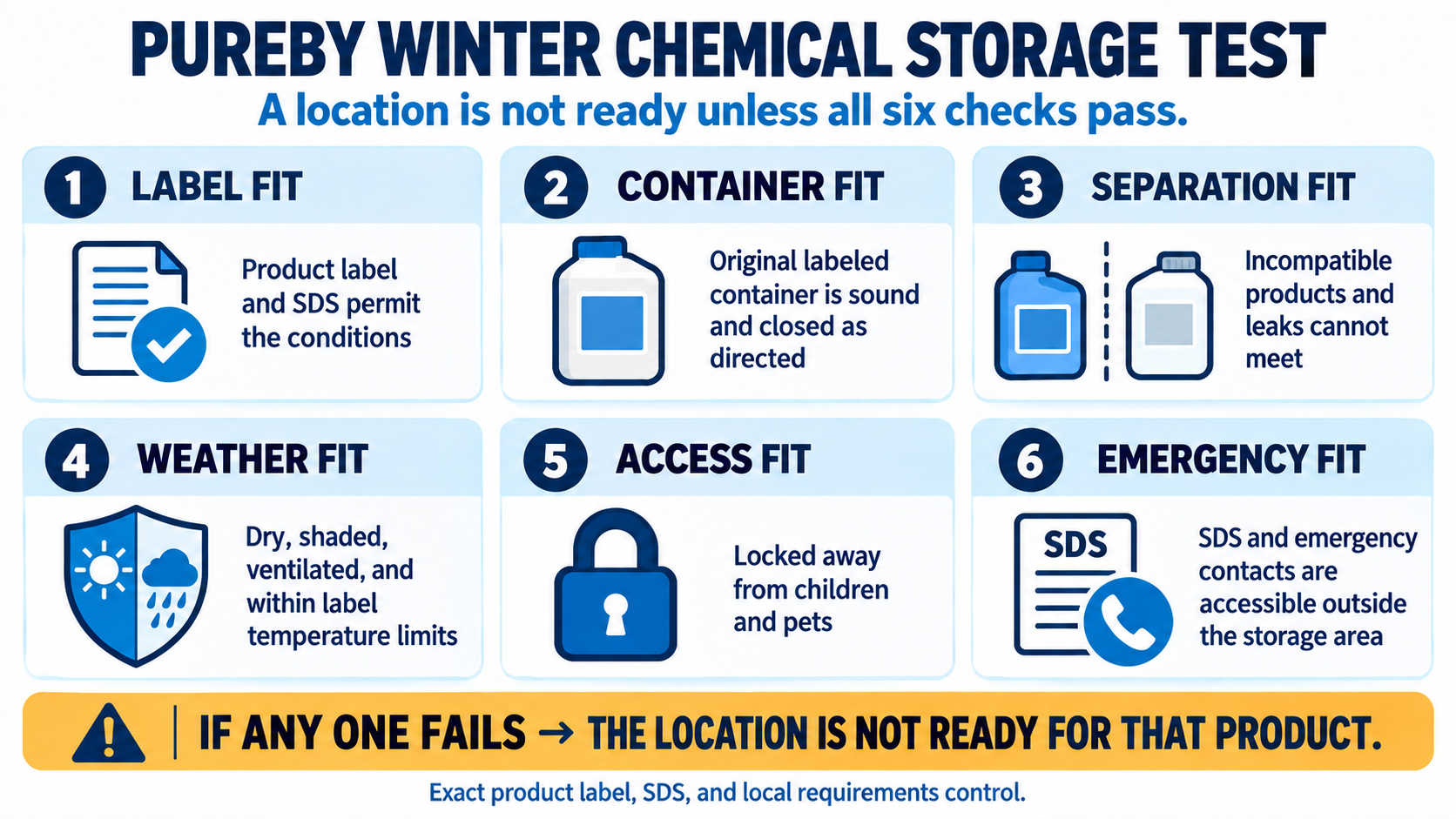
The PUREBY Six-Point Winter Storage Test is a screening framework, not a chemical compatibility chart. The exact product label, SDS, and local requirements control.
This is a pre-storage screen, not a chemical compatibility chart. When the label or SDS is unclear, contact the product manufacturer or a qualified pool professional before moving the container.
Make a written inventory before winter so no unlabeled, damaged, or forgotten container is carried into the storage season.
Record:
Do not identify a chemical by color, smell, tablet shape, or the type of bucket. Pool products with similar appearances can contain incompatible ingredients.
Set aside—without combining—the products that are unwanted, deteriorating, or no longer identifiable. The CDC recommends contacting the manufacturer or the appropriate local or state hazardous-materials program for disposal instructions rather than guessing.
The product label—not a generic online storage temperature—determines how that chemical should be stored through winter.
Read the sections titled:
Then review the current SDS, especially the sections for hazards, accidental release, handling and storage, stability and reactivity, and disposal.
Different products can require different winter conditions. For example, the CDC recommends storing pool chemicals below 95°F (35°C) and within the manufacturer’s conditions, but an individual label may set a lower maximum temperature or require protection from freezing. One EPA-registered pool product label, for example, requires storage above 32°F because freezing can cause product separation. That is evidence for checking the exact label—not a universal 32°F rule for all pool chemicals.
Do not remove a warning label, cover it with a handwritten label, or rely on a photo as the only identification. Keep a digital copy of the label and SDS for reference, but preserve the manufacturer’s label on the original container.
A convenient space is suitable only if it remains dry, ventilated, secure, within the product’s temperature range, and separated from people, ignition sources, fuel, and incompatible chemicals.
Use this table as a screening tool—not as permission to use a location that conflicts with a label or local code.
| Possible location | Why homeowners consider it | What can make it unsuitable |
|---|---|---|
| Dedicated locked chemical-storage area | Can provide controlled access and organized separation | Still needs label-compatible temperature, ventilation, moisture protection, compatible shelving, separate containment, and code compliance |
| Detached shed | Keeps chemicals away from living space | Extreme heat or cold, condensation, roof leaks, direct sunlight, fertilizer, paint, fuel, lawn equipment, and poor ventilation |
| Garage | Easy to access and may stay warmer than a shed | Vehicles, gasoline, oil, paint, power equipment, water heaters, floor drains, freezing or overheating, and access by children or pets |
| Basement, laundry, or utility room | May avoid outdoor freezing | Shared indoor air, furnaces or water heaters, drains, humidity, household cleaners, food, and exposure to occupants |
| Pool equipment room | Close to the pool | Moisture, corrosion, heat, pumps or heaters, chemical feeders, cramped separation, and unauthorized access |
| Outdoor deck box or general storage tote | Low cost and weather-resistant appearance | Water intrusion, condensation, solar heat, trapped vapors, no verified ventilation, and accidental co-storage of incompatible products |
The CDC advises protecting chemicals from heat, flames, direct sunlight, and water, and specifically warns against keeping gasoline-, diesel-, or gas-powered equipment in the chemical storage area. That makes many multipurpose garages and lawn-equipment sheds poor choices unless a compliant, genuinely separate storage arrangement has been established.
Do not add a portable heater, heat lamp, or improvised electrical warming device to a chemical storage space. If the product needs freeze protection, select a compliant location approved by the label and local requirements; do not create a new ignition or overheating hazard.
Never transfer a pool chemical into a food container, drink bottle, unmarked bucket, or an old container that held another product.
Keep each chemical:
Do not reuse an empty pool chemical bucket for another chemical. Residue can remain even when the container looks clean.
An airtight outer tote is not automatically safer. The EPA pool chemical alert notes that some pool chemicals are packaged in breathable containers to prevent pressure buildup. Do not place a chemical in an airtight secondary enclosure, repackage it, or alter its venting unless the product manufacturer specifically permits that arrangement.
If the original container is cracked, wet, corroded, missing its label, or otherwise damaged, do not pour the product into a substitute container. Contact the manufacturer or local hazardous-materials authority for product-specific instructions.
“Pool chemical” is not one compatibility group: chlorine products, acids, oxidizers, cleaners, fuels, and organic materials must not be treated as interchangeable or stored where a leak can bring them together.
At minimum:
The CDC storage poster specifically says to separate incompatible chemicals such as acid and chlorine, keep different chemicals from mixing, keep liquids low, and retain original labeled containers. The EPA pool chemical alert additionally advises not mixing old product with fresh product—even when it appears to be the same type.
Do not use one large spill tray for incompatible chemicals. Secondary containment is intended to prevent leaks from meeting, not to collect them in a common basin. The container, shelf, tray, and cabinet materials must also be compatible with the exact chemical; confirm this through the label, SDS, manufacturer, or a qualified professional.
| Product type | Winter storage question to answer before keeping it |
|---|---|
| Chlorine tablets, granules, or shock | Is the container completely dry, isolated from acids, other chlorine formulations, moisture, combustibles, and contaminated tools? |
| Liquid chlorine or sodium hypochlorite | Is it upright, stored low, protected from heat and sunlight, separated from acids and ammonia, and within its labeled temperature and shelf-life limits? |
| Muriatic acid or dry acid | Is it physically separated from every chlorine product and stored in a label-approved, corrosion-compatible area? |
| Algaecide, clarifier, stain treatment, or sequestering product | Does the exact label require freeze protection or another temperature range, and is the liquid isolated from incompatible products? |
| Test-kit reagents | Does the kit specify a storage temperature or replacement date, and can the reagents remain separate from treatment chemicals? |
| Salt, alkalinity increaser, calcium product, or stabilizer | Can the product remain dry, identified, and separated as its label requires? |
This table is intentionally incomplete. Two products in the same broad category may still have different active ingredients, concentrations, packaging, and incompatibilities.
Winter moisture can be as important as winter temperature because water entering some concentrated pool chemicals can trigger heat and gas release.
Inspect the proposed storage space for:
Where the label and local requirements allow, keep containers off the floor on sturdy, chemically compatible shelving or pallets. Do not place a container high enough that it could fall or leak onto another product, and never store a liquid above a dry chemical.
Do not hose down a chemical-storage area or clean it with a product that may be incompatible with the stored chemicals. Use the cleanup method specified by the chemical manufacturer and keep dedicated cleanup materials separate for each compatible group.
There is no universal winter temperature that is safe for every pool chemical.
The CDC’s general ceiling of 95°F (35°C) does not replace a lower product-specific maximum. Likewise, not every dry chemical needs heated storage, while some liquid products explicitly say “protect from freezing.”
Use this decision sequence:
Do not use a chemical that has frozen, separated, expanded, leaked, or changed appearance until the manufacturer confirms what to do. Do not shake it, warm it with an appliance, mix it back together, or pour it into another container on your own.
Periodic visual checks can catch moisture, corrosion, and container damage before a homeowner reaches for the product in spring.
From a safe distance, look for:
If the area is dry and normal, keep the containers closed and avoid unnecessary handling. If a container is damaged but shows no active reaction, keep people and animals away and contact the manufacturer or local hazardous-materials program before moving it.
If a container is hot, swollen, hissing, smoking, reacting, or releasing an irritating odor, do not open it, reseal it, add water, carry it outdoors, or attempt a household neutralization. Leave the area, prevent others from entering, and call 911 or the local fire department from a safe location.
A homeowner should not improvise cleanup, neutralization, transport, or firefighting when the product identity or container condition is uncertain.
| What you find | Immediate safe action | Who to contact |
|---|---|---|
| Unreadable label or an unknown product in a stable container | Do not open, combine, smell, or repackage it; keep people and pets away | Manufacturer if identifiable; otherwise the local household hazardous-waste or hazardous-materials program |
| Stable damaged container or limited seepage with no unusual heat, gas, smoke, visible vapor, strong irritation, or active reaction | Do not handle, move, or clean it by guesswork; isolate access to the area | Product manufacturer and local household hazardous-waste or hazardous-materials program for exact instructions |
| Container showing an active reaction, significant ongoing release, visible vapor or smoke, unusual heat, bulging, hissing, fire, or strong respiratory or eye irritation | Leave the area immediately and prevent re-entry | 911 or the fire department from a safe location |
| Eye, skin, inhalation, or ingestion exposure | Move away from the source and follow the product label’s first-aid directions; do not induce vomiting unless directed | Poison Help at 1-800-222-1222; call 911 for breathing difficulty, collapse, seizure, or other severe symptoms |
This is an escalation table, not a spill-cleanup procedure. Emergency responders and the exact product label determine the appropriate response.
Unwanted, deteriorating, or unidentified pool chemicals need product-specific disposal—not a universal trash, drain, or backyard solution.
Start with the product’s Storage and Disposal directions. If the label does not resolve the situation, contact:
Do not pour unwanted pool chemicals into a sink, toilet, storm drain, yard, or pool unless the exact label and local authority explicitly direct that action. Do not combine leftovers to reduce the number of containers. Do not put an unknown chemical in household trash.
Keep these numbers and documents outside the storage area:
If chlorine-containing gas or irritating vapor is released indoors, CDC guidance is to get away from the release, leave the building, get to fresh air, and seek help. Do not re-enter to retrieve the container or paperwork.
Yes, but only when the product remains within its shelf life and every label, container, separation, temperature, moisture, security, and local-code requirement can be met.
Do not keep a product merely because the bucket is not empty. Disposal may be the safer choice when:
Never pour an old product into a new container, and never blend old and fresh chemical to “use it up.” Keep it isolated and obtain product-specific instructions.
The most serious mistakes create a path for moisture, incompatible leaks, heat, or unauthorized access.
| Mistake | Why it is risky | Safer approach |
|---|---|---|
| Putting every pool chemical in one cabinet or tote | A leak can bring incompatible products together | Use label-approved physical separation and separate compatible containment |
| Storing chlorine beside muriatic acid | Contact can release toxic gas and heat | Keep acids and chlorine in separate dedicated locations as labels and codes require |
| Treating all chlorine products as the same | Different formulations can react if mixed or contaminated | Keep cal-hypo, dichlor, trichlor, and other formulations separate with dedicated tools |
| Moving chemicals into drink bottles or generic buckets | Identity, warnings, and first-aid information are lost; residue can react | Keep the original manufacturer-labeled container |
| Placing liquids on a high shelf above dry products | A leak can contaminate the product below | Store liquids low and never above solids |
| Using one scoop for shock, tablets, and pH products | Residue transfers an incompatible chemical | Keep one clean, dry, dedicated tool for each product |
| Storing beside a mower, gasoline, paint, or oily rags | Oxidizers, fuel, and combustibles can create severe fire hazards | Use a separate area free of fuel, powered equipment, and combustibles |
| Assuming a shed is cold but safe | The product may freeze, overheat in sun, or get wet from condensation | Verify actual seasonal conditions against each label |
| Assuming a basement is automatically better | Shared air, ignition sources, cleaners, drains, and occupants create other risks | Evaluate the complete location, label, ventilation, and local requirements |
| Trying to fix a hot, wet, swollen, or fuming container | Moving, opening, adding water, or resealing can intensify the reaction | Evacuate and call emergency responders from a safe location |
Only if the exact product label, SDS, and local requirements allow it and the garage provides a genuinely dry, ventilated, locked, temperature-compliant area separated from vehicles, gasoline, oil, paint, power equipment, ignition sources, household cleaners, food, children, and pets. Many ordinary garages fail several of those checks.
The answer depends on the exact product and concentration. Some liquid pool products explicitly require protection from freezing, while many dry chlorine products focus on keeping the material cool, dry, and uncontaminated. Never use one minimum temperature for every chemical; follow the exact label and ask the manufacturer what to do if a product froze or separated.
Do not store them on the same shelf, in the same cabinet, in the same tote, or over one another. They are incompatible and must be kept in separate dedicated locations with separate containment as their labels, SDSs, and local fire requirements direct. If the shed cannot provide compliant separation, it is not a suitable shared storage space.
Do not treat them as one product. Cal-hypo, dichlor, trichlor, liquid chlorine, and other chlorine products can have different incompatibilities and storage instructions. Keep them in their original labeled containers, physically separated, and use a dedicated dry tool for each product.
Not unless the product manufacturer specifically approves that setup. Do not repackage chemicals, cover required vents, or assume an airtight outer tote is safe. It may trap heat, moisture, or vapor, and some pool chemicals use breathable packaging to prevent pressure buildup.
Avoid locations where floor moisture, flooding, snowmelt, or a backed-up drain can reach the container. The EPA recommends keeping chemicals off wet floors on sturdy, compatible shelving or pallets, while also preventing falls and cross-leaks. Follow the label, SDS, and local code for the exact storage arrangement.
Follow the product’s disposal directions. If the product is deteriorating, unidentified, contaminated, or not accepted by ordinary trash service, contact the manufacturer and your local household hazardous-waste or hazardous-materials program. Never combine leftovers or pour them into a household or storm drain by guesswork.
Do not touch, open, move, reseal, wet, or neutralize it. Get everyone away, leave the building if the release is indoors, and call 911 or the fire department from a safe location. For a possible exposure in the United States, call Poison Help at 1-800-222-1222; call 911 immediately for breathing difficulty, collapse, seizure, fire, or an active chemical reaction.
Safe winter pool chemical storage is a compatibility and containment problem—not simply a search for the coldest shelf.
Before keeping any product until spring, confirm six things: the exact label permits the environment, the original container is sound, incompatible materials cannot meet, water cannot reach the product, children and animals cannot gain access, and emergency information remains available outside the storage area.
Keep chlorine away from acids. Keep different chlorine products separate. Keep liquids low, protect every product from external water, and keep every container identified. Do not share scoops, combine old and new product, or improvise a warmer location near a heater or fuel-powered equipment.
If it is also time to close the pool, use PUREBY’s U.S. climate-zone guide to pool closing to plan around local freeze risk. Then follow the separate equipment steps in How to Winterize an Above-Ground Pool Pump, Hoses, and Skimmer. Chemical storage and equipment drainage are related closing tasks, but one does not replace the other.
Written by: Catherine Z.
Chemical-safety review by: David Gilbert
Last reviewed: September 30, 2026